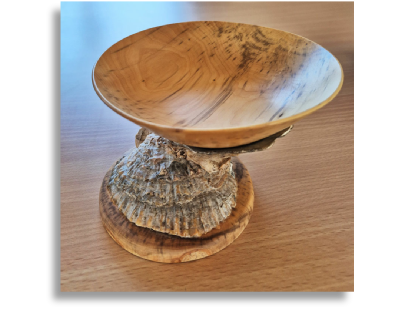
Raising a bowl on a foot changes its relationship with the surface beneath it. The space under the bowl becomes part of the composition, and the support can make an ordinary container appear more formal. The foot is therefore more than a detail hidden underneath the main form.
Consider the transition between the bowl and its support. A sudden step can emphasise the two parts; a gradual curve can make them read as one continuous object. Both approaches can be effective when the choice is deliberate. The question is whether the transition strengthens the overall outline.
Height also affects how the bowl is seen. A higher support may expose more of the underside, whereas a low foot leaves the upper body dominant. Drawing the same bowl with different supports is a useful exercise because it isolates a single design decision. Keep the bowl unchanged and compare the resulting silhouettes.
In a group display, footed bowls can introduce a change of level among lower objects. That variety should serve the arrangement rather than overwhelm it. Study the archive illustration and note how much of the visual character comes from the bowl itself, and how much comes from the space beneath it.